

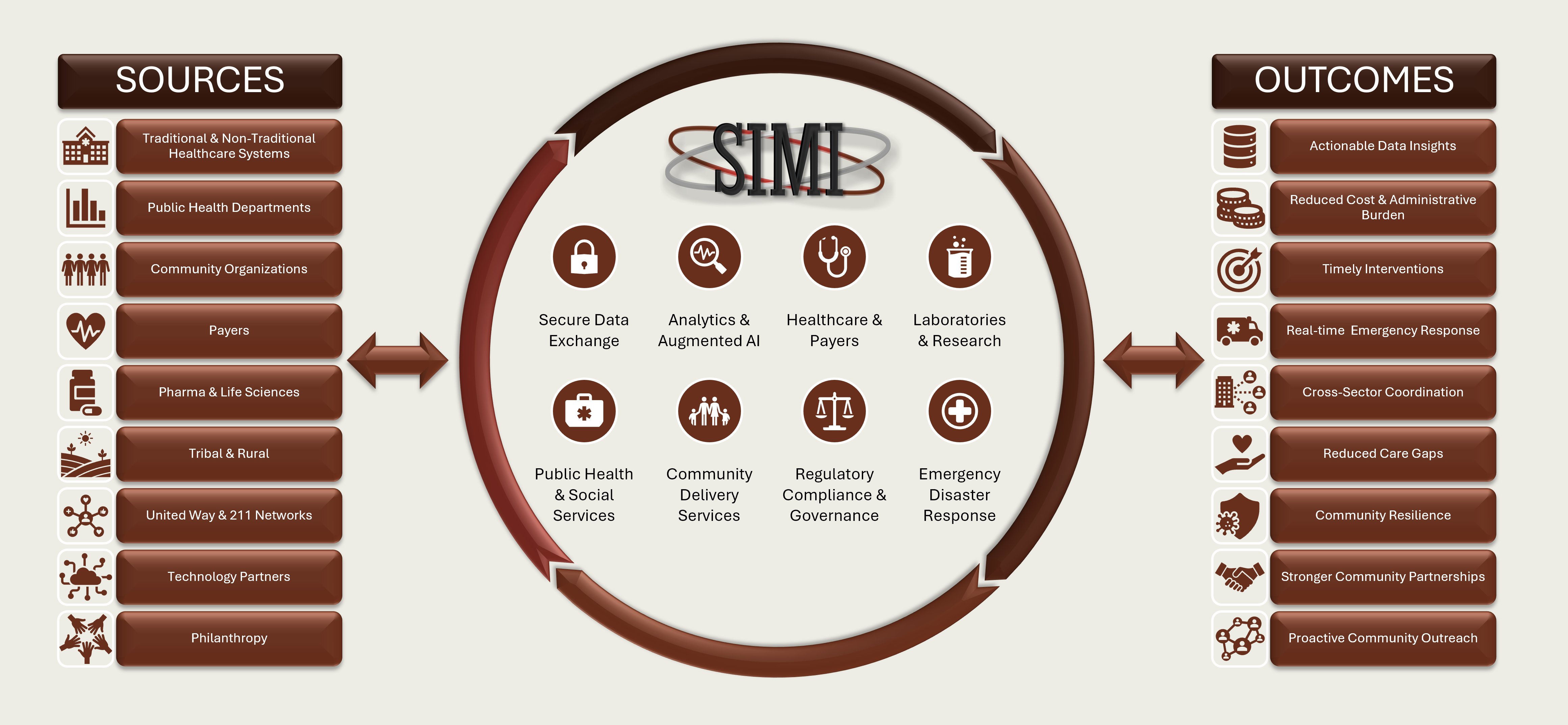
The Community Delivery Initiative™ (CDI™) is a practical, field-tested framework for broadening the reach of care.
It brings together community partnerships, trusted data, modern technology, and coordinated follow-through so that
health and wellness services can reach people where they live, work, play, gather, worship, learn, and receive support.
CDI responds to a simple but urgent reality: improving health outcomes requires more than better systems or faster
data exchange. It requires trust, collaboration, and the ability to deliver timely services in community settings,
supported by information that is secure, governed, accurate, and actionable.
The COVID-19 pandemic showed what communities can accomplish when healthcare systems, public health agencies,
local organizations, volunteers, schools, and trusted messengers work together under pressure. It also exposed
the limits of fragmented systems, delayed data, incomplete information, and disconnected follow-up. As communities
moved beyond the crisis phase, a new question emerged:
How do we preserve what worked, improve what did not, and make community-based care sustainable?
CDI was developed to answer that question.
CDI extends the lessons of emergency response into a sustainable model for community-based care.
It is designed to help communities organize, deliver, document, and follow up on services in ways
that are secure, transparent, equitable, and adaptable to local needs.
CDI is not a one-size-fits-all program. It does not impose rigid workflows or require communities to
rebuild existing systems. Instead, it provides shared infrastructure, adaptable playbooks, practical
operating models, and reusable tools that communities can configure around their own priorities,
partners, populations, and resources.
A key part of this model is data quality. Information gathered in community settings must be accurate enough
to support clinical decision-making, care coordination, public health insight, and community benefit reporting.
CDI supports validation, governance, feedback loops, and continuous refinement so that data can be trusted before
it is shared, analyzed, or acted upon.
CDI is supported by an integrated technical foundation built around Security, Interoperability, Messaging,
and Imaging, together with a growing partner ecosystem. Core components include:
Vaccinations, Information, Education, Wellness, and Screening™ — VIEWS™
The community-facing intelligence layer that supports outreach, registration, screening,
service delivery, situation awareness, and event-based workflows.
Health, Wellness, and Response Hub™ — HWR Hub™
The secure, privacy-preserving backend that enables cross-organizational and regional coordination.
These platforms are delivered as secure, scalable, cloud-based services that operate at the
edge—where data enter and leave organizational control. The goal is to make information more
complete, timelier, and more useful while protecting privacy and supporting appropriate governance.
At its core, CDI is about individuals, families, neighborhoods, and communities.
It is about restoring trust in systems that too often fail to meet people where they are.
Healthcare delivery does not occur only in hospitals or clinics. It also happens at health
fairs, schools, churches, community centers, tribal lands, rural facilities, mobile outreach
sites, grocery stores, and other trusted community locations. CDI recognizes this reality and
provides a framework that bridges community-based access points with clinical care, social
services, and ongoing support.
To see how CDI works in practice, consider Maria’s story.
Maria is a 52-year-old woman living in a rural community. She has Type 2 diabetes
but has not had an eye exam in more than two years. Spanish is her primary language.
She has limited transportation options, works hourly jobs with little flexibility,
and does not fully understand the importance of routine eye screening.
Like many individuals in her community, Maria is at risk for preventable vision loss but
is not actively engaged in care.
Maria’s niece is involved in Students for Health Impact™ (S4HI™), a workforce and community
health initiative that connects students, technology, and service learning. Her niece encourages
Maria to attend a local community health event using a diabetic and cardiovascular care
transformation model.
When Maria arrives, she is welcomed by a bilingual community health worker who helps her register,
provide family and clinical history, and understand the process in her preferred language.
Maria then completes several screening stations. Her A1c is elevated. Her blood pressure is high.
Her lipid results are abnormal. For the first time, Maria understands that her diabetes is poorly
controlled and that she needs follow-up care.
At the imaging station, a trained technician captures retinal images using a fundus camera. The images
are securely uploaded and combined with Maria’s clinical screening results. Behind the scenes, her
image quality is checked, her results are triaged and risk assessed, and her case is flagged for
expedited clinical review by an offsite reading center. AI tools may assist in quality assessment
and triage, but clinical interpretation and care planning remain with qualified clinicians.
While Maria waits for her retinal results, she chooses to complete a vision exam. A remote clinician
performs a refraction exam, and the results are checked for quality and completeness before submission.
Maria receives a prescription and, through community partnerships, becomes eligible for low or no-cost glasses.
The experience is immediate and practical. Instead of navigating multiple appointments, transportation barriers,
and uncertain referrals, Maria moves from screening to solution in a single community-based encounter.
The remote clinical review later identifies early diabetic and hypertensive retinopathy — serious but
treatable conditions. The results are documented, a care plan is developed, and the findings are
explained to Maria and her community health worker by a clinician.
Maria now understands both the urgency and the path forward.
CDI does not stop at screening or referral. It supports coordinated follow-up,
including electronic referrals, consultation support, updates to the patient’s
primary care home, connection to Trusted 211 services, transportation and language
support, Community Information Exchange coordination, and ongoing engagement
with a bilingual Community Health Advocate.
Maria attends her follow-up appointments with a support ecosystem tailored to
her needs. Care begins earlier. Disease progression can be slowed. Future
screenings are scheduled. The health system closes a critical gap in care,
and the community gains a more accountable model for reaching residents who
might otherwise be missed.
CDI enables much more than education or basic screening. The framework can support:
CDI also supports shared playbooks for outreach planning, consent models, volunteer coordination, event workflows, referral pathways, and post-event reporting. These resources help communities learn from one another while adapting the model to local conditions.
SIMI is supporting a limited number of readiness evaluations and
production deployments to help communities apply the CDI framework.
These efforts are not about compliance mandates or rigid implementation
models. They are about shared learning, practical experience, and
building momentum for healthier, more resilient communities.
CDI reflects a simple idea: when trusted data, modern technology,
and community partnerships come together, care can reach further,
faster, and more equitably.
For nearly three decades, SIMI has worked at the edges of healthcare,
public health, community systems, and technology — where policy, trust,
interoperability, cybersecurity, privacy, resilience, and real-world
delivery converge.
Many issues now dominating national and global conversations are not
new to SIMI: data quality, secure exchange, responsible governance,
community-based care, AI-enabled workflows, public health reporting,
privacy-preserving interoperability, and resilient communications.
These challenges have been identified, confronted, and solved in real
environments, often long before they became mainstream priorities.
As SIMI approaches its 30th anniversary, the organization is entering
its next chapter as an Independent Software Vendor (ISV) and Global Systems Integrator
(GSI) working alongside a growing Impact Alliance. This alliance brings together
small firms, local nonprofits, community organizations, healthcare partners,
and global technology leaders — combining deep local presence with the ability
to scale responsibly, securely, and effectively.
SIMI continues to take on challenges that others avoid because they are complex,
cross-cutting, and require trust across institutions and sectors. Through its growing
network, SIMI can tailor solutions for neighborhoods, rural communities, tribal
settings, and regional collaboratives — while operating with the rigor, resilience,
and reach needed for broader deployment.
The Hot Topics below reflect current challenges where communities, funders,
health systems, public agencies, and technology partners are searching
for practical ways to move from ambition to execution.
Across the country, regions are forming collaboratives to
pursue major funding opportunities, including rural health
transformation programs, philanthropic initiatives, and
public-private partnerships. Yet a consistent challenge remains:
the most important work often must happen before funding applications
are submitted.
Shared governance structures must be established. Non-supplantation
requirements must be understood and operationalized. Participation
must be de-risked for frontline providers, community organizations,
and tribal partners operating with thin margins and limited capacity.
Fiscal and operational sustainment must be considered from the start.
Without this groundwork, even well-funded initiatives can struggle to
turn ambition into measurable impact.
Readiness requires partners to clarify roles, define data responsibilities,
align services, identify gaps, and demonstrate that proposed models can
work in real-world conditions. Communities need practical frameworks that
preserve local control while enabling coordinated action across healthcare,
public health, social services, and community-based organizations.
The opportunity is to build shared approaches that support earlier detection,
faster triage, timely referral, and accountable follow-up — especially for
chronic conditions where early intervention can materially change outcomes
and reduce downstream cost.
This work must also account for connectivity gaps, transportation barriers,
workforce shortages, limited specialty access, and disaster risks such as
wildfires, floods, earthquakes, hurricanes, or prolonged power disruptions.
Secure, resilient communications and governed data workflows are increasingly
essential to continuity of care.
The challenge is clear: build readiness before funding arrives,
so collaboration can become sustained, measurable community impact.
Across healthcare, public health, and payer environments,
there is growing agreement that improving outcomes requires
reaching people earlier and extending care beyond traditional
clinical settings.
Vision health provides a powerful example. Eye exams can reveal
risks related to diabetes, hypertension, cardiovascular disease,
and other systemic conditions. Yet access to timely screening
remains uneven, especially in underserved, rural, tribal, and
economically constrained communities.
Historically, innovation in this area has focused on clinical tools
and devices inside existing care settings. Those advances matter,
but they do not solve the broader challenge: how to deliver complete
care workflows in community settings, where people actually live,
work, play, gather, and seek help.
The harder problem is not the screening itself. It is the
pathway around it: outreach, consent, intake, image capture,
data quality, clinical review, risk prioritization, referral,
transportation, language support, primary care coordination,
and closed-loop follow-up.
Community-based eye screening should not be treated as an endpoint.
It should be a starting point connected to rapid assessment, care planning,
and a clear pathway to treatment. Screenings conducted at community events,
mobile clinics, tribal facilities, rural sites, or non-traditional venues
need to connect to clinical expertise and care networks in ways that are
timely, governed, and sustainable.
This approach is especially important for Federally Qualified Health Centers
(FQHCs), tribal health programs, safety-net clinics, and rural providers
facing workforce shortages, equipment gaps, and geographic barriers.
By extending specialty reach without requiring every community to recreate
specialty infrastructure, these models can help act earlier—before vision
loss occurs, disease progression accelerates, or preventable complications
drive higher costs.
For funders, payers, life-sciences partners, and community benefit leaders,
the larger opportunity is to create responsible, governed models that improve access,
generate real-world evidence, preserve local control, and strengthen regional collaboration.
Better care is not a matter of technology alone. It requires trusted partnerships,
operational discipline, embedded governance, and delivery approaches that fit
real community conditions.
Healthcare organizations are caught in a growing tension
between federal interoperability expectations and long-standing
privacy and disclosure obligations.
Federal data exchange rules and interoperability programs encourage
broad availability of clinical data. In practice, this is often
interpreted as transmitting the full U.S. Core Data for Interoperability
(USCDI) dataset, even when reporting to public health or supporting
narrowly defined use cases.
At the same time, healthcare organizations remain responsible for
Minimum Necessary and Appropriate Disclosure (MNAD) requirements under
HIPAA, state privacy laws, contractual obligations, and patient trust
expectations.
This conflict became visible during the COVID-19 pandemic. Under emergency
pressure, many organizations adopted accelerated reporting approaches
that sent full clinical records—including progress notes and highly sensitive
information—outside their direct control, often without clear guidance on what
data were required, how long they would be retained, or how they would be reused.
Public health agencies understandably value comprehensive data for surveillance,
research, preparedness, and response. But willingness to receive broad data does
not resolve the originating healthcare organization’s responsibility to disclose
only what is appropriate for the purpose.
The implications extend beyond pandemic reporting. Laboratory results, encounters,
immunizations, case reports, syndrome surveillance, population health studies,
and AI-enabled analytics can raise similar concerns when data leave organizational
control.
The emerging need is for governed processes that enforce minimum necessary disclosure
at the boundary, before data leaves organizational control. This includes validation
and segmentation based on purpose and context, purpose-bound disclosure, auditability,
traceability, Zero Trust principles, and privacy-preserving approaches that reduce
unnecessary exposure.
The goal is not to weaken public health or limit responsible data use. It is to restore
discipline, accountability, and trust in how data are shared.
Interoperability should advance without sacrificing privacy, compliance, or
public confidence.
Medicaid and Medicare transformation is no longer about
defining the next program, waiver, or payment model. Across
Accountable Care Organizations (ACOs), value-based care
initiatives, and state-led demonstrations, the direction is clear.
What remains difficult is execution at the community level,
where individuals and families actually experience care—or encounter
barriers to accessing it.
Transformation can begin locally by reducing friction, simplifying
navigation, connecting trusted partners, and redesigning how services
are delivered, coordinated, and supported in everyday life. Too often,
transformation efforts focus on coverage, portals, eligibility systems,
or referral platforms while overlooking the real costs borne by individuals:
time, confusion, transportation, language barriers, repeated intake processes,
missed work, and loss of trust.
Meaningful transformation starts where people already are. This goes beyond
traditional access to care, especially in urban environments where services
may exist but remain practically unreachable. It also moves beyond disconnected
no wrong door
websites and referral systems that rarely function as intended.
Trusted community organizations already reach many of the people most affected
by Medicaid and Medicare transformation efforts. United Way, Easterseals,
211 systems, tax preparation programs, benefit navigation efforts, crisis
support services, community health workers, and local nonprofits all represent
touchpoints that can be strengthened and connected.
The opportunity is to create shared, governed models for closed-loop referrals,
education, follow-up, and coordinated support across healthcare, human services,
social services, and community resources.
The result should not be another silo. It should be a community-level operating
model that reduces burden for individuals, families, providers, and systems.
For funders and philanthropies, this is a practical opportunity to invest in
measurable, governed, scalable pilots that address fragmentation now. Realizing
the future of Medicaid and Medicare does not begin with policy documents.
It begins in communities — by making care easier to reach, simpler to navigate,
and worthy of trust.

Enabling Care and Outbreak Response Where it Matters Most through AI-Augmented Workflows

Enabling Care and Outbreak Response Where it Matters Most through AI-Augmented Workflows

Enabling Care and Outbreak Response Where it Matters Most through AI-Augmented Workflows

Enabling Care and Outbreak Response Where it Matters Most through AI-Augmented Workflows
Healthcare does not lack innovation. Across healthcare,
public health, life sciences, and technology, organizations
are advancing new models of care, diagnostics, therapies,
and digital capabilities at an unprecedented pace. Yet
despite this progress, persistent challenges remain — including
workforce scarcity, fragmented systems, operational friction,
inequitable access, and the growing complexity of coordinating
care across distributed environments.
SIMI’s Broadening the Reach of Care™ strategy is built on a
forward-leaning premise: innovation creates meaningful value only when
it can be operationalized securely, responsibly, and at scale within
real-world care delivery. This includes the disciplined use of AI,
interoperable health information technologies, resilient communications,
and governed workflows that strengthen — rather than disrupt — the
people and systems at the center of care.
This is not a standalone AI product or isolated technology
initiative. It is an integrated operational strategy across SIMI’s
Community Delivery Initiative™ (CDI™),
Public Health Data Exchange™ (PHDX™),
Public Health Assist™ (PH-Assist&trade),
Vaccinations-Information-Education-Wellness-Screening™ (VIEWS™),
Health, Wellness, and Response Hub™ (HWR Hub™), and
Students for Health Impact™ (S4HI™)
initiatives — designed to broaden the reach of care responsibly, securely,
and sustainably across communities, health systems, and public-sector environments.
SIMI applies AI in environments where operational impact
is most critical and valuable. This includes community-based care
delivery, interoperability workflows, imaging and screening
support, referral coordination, and population engagement.
By embedding AI directly into governed workflows
and real-time decision environments, SIMI ensures
that technology strengthens care delivery without
introducing fragmentation, risk, or loss of
control—expanding access while preserving trust,
accountability, and clinical integrity.
SIMI’s approach to broadening the reach of care is grounded in
three interdependent foundations, each designed to enable scale,
maintain trust, and ensure that innovation translates into real-world impact.
1. Care Delivery Initiative (CDI)
SIMI reimagines how care is delivered so that expertise
can extend beyond the physical presence of
clinicians— without removing human judgement from decision making.
This includes:
The goal is not to replace clinicians.
It is to empower clinicians to reach more
people effectively, consistently, and sustainably,
while maintaining quality, trust, and accountability.
2. Secure ICT as the Backbone
Modern healthcare delivery requires secure,
resilient infrastructure capable of connecting people,
systems, devices, and workflows across distributed environments.
SIMI approaches this through:
Within this model, infrastructure is not separate
from care delivery. It is the foundation that enables
care delivery to scale—securely, reliably, and in
alignment with regulatory and operational requirements.
3. AI Applied with Discipline
SIMI applies AI in areas where it delivers measurable operational value, including:
AI capabilities are implemented within a governed framework that includes:
AI is not used to replace clinical judgment, community leadership, or human responsibility. Instead, it is deployed as operational infrastructure—designed to support people, extend capacity, and improve decision-making without displacing the professionals and communities it serves.
Broadening the Reach of Care is designed to create value
across the healthcare ecosystem without shifting risk or
operational burden onto others. This approach aligns
innovation with real-world constraints, ensuring that each
stakeholder benefits from improved coordination, efficiency,
and outcomes.
Health Systems & Providers
Challenges
Workforce strain, specialty shortages, administrative burden, and fragmented operations.
What SIMI Enables
Result
Care reaches more patients using the same — or fewer — constrained
resources, improving both efficiency and quality of care delivery.
Public Sector & Government
Challenges
Scale, equity, accountability, sustainability, and maintaining public trust.
What SIMI Enables
Result
Expanded access, stronger continuity of services, and responsible stewardship of public resources.
Managed Care Organizations & Payers
Challenges
Rising costs, fragmented member journeys, uneven engagement, and avoidable utilization.
What SIMI Enables
Result
Improved health outcomes, stronger member experience, and scalable cost control.
Retail Health
Challenges
Delivering consumer-facing care at scale without sacrificing trust, quality or continuity.
What SIMI Enables
Result
Retail healthcare becomes an integrated, trusted component of
care delivery—rather than a disconnected or parallel channel.
Pharma & Life Sciences
Challenges
Ensuring therapies achieve measurable real-world impact beyond controlled clinical environments.
What SIMI Enables
Result
Therapies achieve stronger real-world impact,
improved patient outcomes, and sustained long-term value.
Funders & Philanthropy
Challenges
Creating measurable, equitable, and sustainable community impact.
What SIMI Enables
Result
Durable infrastructure that continues delivering measurable value long after initial funding.
Technology & Strategic Partners
Challenges
Deploying AI responsibly across complex, highly regulated healthcare ecosystems.
What SIMI Enables
Result
AI becomes scalable operational infrastructure — supporting
real-world outcomes without creating technical debt or governance risk.
Across healthcare leadership, forum discussions, health conferences, and industry analysts, a clear shift is underway: healthcare is entering an execution era.
SIMI’s Broadening the Reach of Care strategy reflects this reality.
It is designed to move beyond innovation as a concept and toward
measurable, real-world impact.
This is not about replacing people. It is about
strengthening the systems and professionals at the
center of care by:
Broadening the Reach of Care represents how SIMI translates innovation into execution — anchored in trust, governed by design, and focused on outcomes that are both measurable and enduring.
SIMI delivers AI as foundational healthcare operating
infrastructure—not pilots, isolated point solutions, or
technology driven by hype.
Across care delivery, data exchange, operational workflows,
and population engagement, SIMI embeds AI directly into real
world environments—securely, responsibly, and at scale.
AI is not the product.
Execution is.
What distinguishes SIMI
SIMI applies AI to extend reach, reduce friction,
and improve continuity—enabling individuals and
organizations to focus on care delivery, informed
decision-making, and maintaining trust.
This approach allows organizations to:
As reflected across healthcare leadership,
forum discussions, health conferences, and
industry analysts, the next era of AI in
healthcare is defined not by increasingly
complex models, but by responsible, scalable
implementation within real operational environments.
Broadening the Reach of Care starts with
establishing the right foundations—where
AI is governed, integrated, and aligned with
the realities of healthcare delivery.
Across healthcare, public health, payer, and life
sciences environments, operational, clinical, and
strategic decisions depend on data that arrives daily
from multiple systems, partners, and workflows. Yet
access to timely data is no longer the primary
challenge – trust is. Incoming records may be incomplete,
inconsistent, delayed, or lacking essential context, and
even small data quality issues can lead to missed
opportunities, misaligned actions, or unintended consequences.
SIMI’s real time data validation, cleansing, and enrichment
capabilities ensure that data meets organizational governance
standards the moment it is created, exchanged, received, or
archived – before it can affect workflows, analytics, reporting,
or regulatory posture. SIMI does not define meaning, thresholds,
or interpretations of your data. Instead, the platform applies
customer-defined rules, contextual standards, and governance
policies to transform incoming records into trusted, actionable
intelligence securely and in real time.
Within SIMI, key data elements are continuously evaluated for:
Validation occurs immediately at the point of
creation or exchange – preventing errors from
propagating across integrated systems or influencing
downstream operational or clinical processes. This
protects decision-making in analytical and reporting
environments that depend on current, governed information
to function effectively.
Real time validation enables organizations to
act with confidence, knowing that decisions
are based on data and information that is
well-understood, trusted, and has already
met their quality and governance expectations.
Traditional data cleansing tools often normalize
data without operational context, forcing records
into standardized formats without regard to how,
when, why, or under what conditions they were captured.
In healthcare and public health environments, this
approach can unintentionally remove or alter meaning
instead of enhancing it.
SIMI performs data cleansing with contextual awareness.
As it flows between clinical practices, laboratories,
public health, community programs, registries, and
administrative systems, SIMI evaluates data in light of:
For example, clinical practices routinely confirm
address information while demographic attributes
such as race and ethnicity may not be updated at
every encounter. SIMI recognizes these realities
rather than treating every missing element as errors,
accounting for evolving value sets, regulatory updates,
and changes in how data is captured over time.
This approach improves usability, ensuring data
quality improvements do not come at the expense of
contextual integrity.
Data becomes valuable when it is placed in context.
SIMI enriches incoming records with additional
dimensions—such as longitudinal relationships,
geographic attributes, and temporal signals—based
on approved organizational logic rather than external
inference engines or opaque analytical models.
Enrichment in SIMI is governed, transparent,
and auditable. Organizations determine:
The result is data that is more complete, more relevant, and more actionable—without surrendering control or introducing unverified assumptions.
SIMI identifies recurring patterns of incomplete,
inconsistent, or outdated data and supports engagement
with upstream contributors who may otherwise lack
visibility into downstream impact.
By supporting closed-loop feedback, SIMI empowers
organizations to engage source systems constructively.
Over time, this improves data quality at its origin
across the broader ecosystem – not solely within
downstream reporting or analytics environments.
This feedback loop strengthens partnerships, reduces
recurring quality issues, and ensures that data quality
improvement is continuous—not reactive.
All real time validation, cleansing, and enrichment processes
operate inside SIMI’s Zero Trust environment, where access is
continuously verified and data usage explicitly authorized
according to policy.
Customer data remains governed according to defined
ownership and stewardship controls throughout the lifecycle.
SIMI does not rely on external open-source AI models or
third-party large language models that require exposure
outside controlled environments – supporting deployment in
highly regulated healthcare and public health contexts.
Within this Zero Trust framework:
This architecture enables SIMI to operate in environments where compliance, privacy, security, and institutional trust are non negotiable operational requirements.
At the core of SIMI’s approach is a
simple principle: the meaning of your
data belongs to you.
Healthcare organizations, public agencies, payers,
and research institutions operate under distinct clinical,
regulatory, operational, compliance, and ethical frameworks.
SIMI does not impose predefined interpretations,
clinical assumptions, or contextual rules.
Instead, the platform provides the infrastructure required to:
As a result, real-time data reflects your operational reality – not a generalized model or external assumption. Insights produced through SIMI are grounded in your definitions, governance, policies, and institutional objectives.
While real time automation reduces manual correction effort and downstream remediation costs, the true value of SIMI’s approach lies in enabling more informed, timely, and accountable decision-making:
SIMI transforms real time data from a potential source of operational uncertainty into a governed strategic asset—securely, transparently, and under organizational control.
Across healthcare, public health, and regional ecosystems,
major investments have modernized how information is transmitted,
standardized, and shared. These efforts have increased the volume
and speed of data exchange across organizations and jurisdictions.
Yet a persistent challenge remains: data are often exchanged before
they are fully trusted, governed, or understood in the right context.
Incomplete records, evolving value sets, unclear reporting intent,
inconsistent interpretation, and downstream reconciliation continue
to create risk—even as interoperability improves. Organizations
are often left to resolve data quality, compliance, and intended-use
questions after information has already moved across organizational or
jurisdictional boundaries.
SIMI addresses this gap by shifting the point of control earlier in
the data lifecycle. Rather than correcting or reinterpreting data
downstream, SIMI focuses on validation, governance, cleansing, enrichment,
and contextual alignment before and at the moment data crosses a boundary.
The result is real-time data that are not only accessible and interoperable,
but also reliable, purpose-aligned, governed, and actionable—supporting
confident decision-making across clinical, operational, technology, public
health, and community environments.
Health data inform decisions that shape outcomes across
the lifespan—from early childhood development through
aging populations. When data are validated, cleansed,
and enriched at the source, they help individuals and
the broader health ecosystem focus on prevention, early
intervention, and long-term well-being.
High-quality, contextually accurate data support more
proactive care. Early identification of something as
routine as vision impairment can affect a child’s educational
experience, reducing behavioral challenges and helping prevent
academic delays. Similarly, advanced, AI-augmented eye screening
can support earlier detection of diabetes, cardiovascular disease,
and other systemic risks — enabling earlier treatment and, in many
cases, preventing irreversible complications.
The examples vary, but the principle remains constant: trusted data
are foundational to prevention, early diagnosis, coordinated care,
and improved outcomes.
At a broader level, trusted population health data benefit individuals,
families, neighborhoods, communities, and regional ecosystems. Reliable
data lead to clearer communication, better decision-making, and more
effective coordination across healthcare providers, public health agencies,
payers, pharmacies, life sciences organizations, and community partners.
High-quality, timely data create direct and indirect
benefits across the entire health ecosystem — from
immunizations at birth and routine preventive care to
infectious disease monitoring and long-term management
of complex conditions such as diabetes, cancer, Parkinson’s
disease, and Alzheimer’s disease.
As data quality improves at the point of origin,
downstream users benefit not only from faster access,
but from more complete, accurate, and continuously refined
information. This reduces reconciliation, strengthens trust
in analytics, and enables more coordinated, proactive
decision-making.
Real-time validation, cleansing, and contextual
enrichment give healthcare organizations a more
reliable view of patient information, improving
clinical decision-making, reporting accuracy, and
operational efficiency.
When data are validated at the point of entry,
duplicates and errors can be resolved earlier,
and records can be enriched with relevant clinical
and standardized context. Closed-loop feedback mechanisms
further strengthen quality over time by identifying
recurring issues and addressing them at the source.
The result includes reduced reporting gaps and rework,
improved quality measure performance, more confident care
coordination, stronger population health management, and
better performance across value-based programs and
reimbursement-linked models.
For example, enhanced immunization queries can identify
missing vaccines based on age, comorbidities, or current
guidelines—helping close gaps earlier and improving performance
across HEDIS scores, Medicare Star Ratings, and other
quality-linked measures.
Pharmacies and retail health providers play a
critical role in expanding access to vaccination
and preventive services. Accurate data captured
at the point of service—including demographics,
insurance information, administration details,
and relevant social context—improves the integrity
of immunization records and strengthens continuity
across the care ecosystem.
Beyond documentation, high-quality data support better
outreach, improved consumer engagement, stronger care
coordination, and closer alignment between services and
community needs.
Data are the oxygen of public health operations.
They support outbreak identification, trend monitoring,
evidence-based action, partner coordination, and public
communication.
Higher-quality data submitted to immunization registries
and public health systems improve patient matching,
deduplication, forecasting, query functions, gap analysis,
and longitudinal record completeness across jurisdictions
and care settings.
By improving trust in the underlying data, public health
agencies can act more decisively and coordinate more
effectively with healthcare and community partners.
Payers, including Medicaid, Medicare, and commercial plans,
depend on accurate, timely data to balance cost management
with quality and outcomes. Managed care organizations,
fee-for-service programs, and ACOs rely on trusted data to
support safe, effective, patient-centered, timely, efficient,
and equitable care.
Trusted data enables organizations to focus on outcomes
rather than operational inefficiencies.
For pharmaceutical and life sciences organizations,
data quality directly affects research integrity,
regulatory readiness, and patient safety.
Data that are validated, cleansed, and enriched before
leaving provider systems, devices, or registries reduce
downstream noise, accelerate analytics, and improve the
reliability of regulatory-grade evidence. This supports stronger
clinical, operational, and observational outcomes; improved
regulatory submissions and audit readiness; and enhanced
pharmacovigilance and patient safety monitoring.
Managing data quality separately across programs,
applications, and organizational units creates
significant administrative overhead. When validation,
cleansing, and contextual interpretation occur in silos,
the result is duplicated effort, inconsistent definitions,
ongoing reconciliation, and increased operational complexity.
As organizations expand their use of advanced analytics,
artificial intelligence, and machine learning, these challenges
become more pronounced. Preparing data for analytical use often
requires additional transformation, quality assurance, and
governance—adding workload for already constrained teams and
increasing cost, compliance, and audit complexity.
SIMI addresses these challenges by shifting data quality processes
upstream, applying unified validation, cleansing, enrichment, and
contextualization at the point of entry and exchange. This approach
eliminates redundant data processing, accelerates governance and
standardization, reduces long-term administrative burden, and improves
readiness for analytics, AI, and regulatory reporting.
By establishing a consistent, governed foundation for data quality,
organizations can reduce reliance on downstream reconciliation while
improving efficiency across clinical, technical, and operational teams.
SIMI delivers real-time data validation, cleansing,
enrichment, and contextualization at the boundary—where
data first enter or leave an organization’s control. This
represents a shift from traditional downstream data
modernization approaches that attempt to resolve quality
and governance issues after transmission or centralization.
SIMI does not replace national platforms,
reporting systems, or interoperability standards.
It complements and strengthens them by ensuring data
are fit for purpose, aligned with intended use, limited
to Minimum Necessary and Appropriate Disclosure requirements,
validated and consistent, and governed according to
organizational and regulatory requirements before exchange
or reuse.
Traditional data modernization has focused on
downstream movement, routing, standardization,
and retrospective reconciliation. These capabilities
are necessary, but they often defer critical questions
of trust, context, and governance until after
information has already been transmitted and
operationalized.
SIMI applies a different architectural model:
addressing data trust, quality, and governance at the
point of interaction rather than treating them as
downstream correction processes.
SIMI focuses on real-time validation and cleansing as
data are created, received, or exchanged; context-aware
interpretation based on organizational rules, workflows,
and regulatory expectations; purpose-bound normalization
and disclosure aligned with intended use; closed-loop feedback
that improves quality at the source; and clear separation
between what is shared, what is retained, and how each is
governed.
By shifting these capabilities upstream, SIMI reduces
reliance on retrospective correction, strengthens integrity
at the moment of exchange, and provides a more durable
foundation for interoperability, analytics, compliance,
and trusted action.
Across healthcare, public health, and community systems,
the challenge is no longer access to technology — it is
managing complexity without increasing risk or burden.
Most organizations already operate within environments
that include numerous applications, platforms, and contracts,
often exceeding what teams can realistically absorb and sustain.
Staff are stretched thin, IT resources are constrained, and
tolerance for disruption is at an all time low.
At the same time, expectations continue to rise.
Executive teams are expected to modernize data exchange,
adopt AI responsibly, strengthen privacy and security controls,
and demonstrate measurable outcomes—all while reducing costs
and avoiding additional administrative load. As a result, the
gap between what organizations are expected to deliver and
what their existing budget, resources and systems can reasonably
support is growing.
This is the environment SIMI is designed for.
Rather than introducing another destination system,
portal, or interface to maintain, SIMI works within
the workflows organizations already depend on. Our
approach prioritizes flexibility over prescription—adapting
to the realities of each customer environment rather than
forcing organizations to adapt to a predefined model. This means
supporting mixed levels of technical maturity, accounting for real
world constraints, and integrating in ways that minimize disruption
to clinicians, operational staff, and IT teams.
In this context, reducing cost is not achieved by
limiting capability. It is achieved by improving
efficiency and reducing unnecessary complexity through:
Much of this complexity is often hidden in the operational details:
multiple logins, inconsistent workflows, proprietary interfaces,
brittle integrations, and technologies that require constant attention
and maintenance to keep running. SIMI addresses this by aligning
interoperability, governance, and delivery into a cohesive operational
model—enabling systems to work together without creating new silos or
fragile dependencies.
As organizations evaluate AI enabled capabilities,
SIMI applies a disciplined approach. AI is deployed to
support people, not replace them—strengthening prioritization,
reducing repetitive manual work, and improving consistency where
it matters most. Governance, security, and accountability are embedded
from the outset, ensuring that AI operates within clearly defined
boundaries and under customer defined rules. This allows organizations
to benefit from AI capabilities without exposing themselves to uncontrolled
automation or new categories of risk.
Security, privacy, and compliance are treated as continuous
operational requirements, not point-in-time certifications.
SIMI operates under Zero Trust principles, enforces controlled
access at the boundary, and aligns every data interaction with
Minimum Necessary and Appropriate Disclosure (MNAD) standards,
consistently following and enforcing customer-defined compliance
and guidance. This approach protects patient data, organizational data,
and intellectual property—while allowing work to continue efficiently
across teams and partner networks.
Equally important, SIMI is designed to operate within rapidly
evolving regulatory and policy environments. Healthcare organizations
must navigate overlapping requirements from multiple authorities,
ongoing updates to interoperability frameworks, and increasing scrutiny
around data usage and retention. Rather than building solutions tied to
narrow interpretations of today’s rules, SIMI provides a flexible foundation
that allows organizations to adapt as expectations change—without requiring
re-procurement, extensive re implementation, or workflow redesign.
For IT teams, this translates into fewer bespoke integrations
to maintain, fewer exceptions to manage, and clearer accountability
across systems. For compliance and risk leaders, it delivers auditability,
defensibility, and transparency, without slowing day to day operations. For
executives, it provides confidence that modernization efforts are reducing
long term risk and cost, rather than shifting them elsewhere in the organization.
The result is a model that enables organizations to move forward intentionally:
This is how SIMI reduces cost, complexity, and administrative burden—by aligning technology, governance, and care delivery with the realities organizations face today, while remaining resilient to the changes they will face tomorrow.
Reducing cost is not achieved by deploying a single tool
or automating isolated tasks. It results from eliminating
the conditions that create unnecessary expense in the
first place: fragmented workflows, duplicated effort,
manual workarounds and systems that do not align with
how organizations operate.
Across healthcare delivery, public health and
community services, organizations face a common
reality. Critical work must continue within environments
that are disconnected, continuously evolving and resource
constrained. Over time, informal processes and compensating
behaviors become embedded in daily operations. These include
manual data reconciliation, redundant reporting, workarounds
between systems and repeated follow-up activities such as phone
calls and fax-based exchanges.
Most of these activities are not formally recognized,
tracked or budgeted. They are absorbed as part of
“the cost of doing business.” In practice, however, they
represent a significant and ongoing source of avoidable expense,
operational inefficiency, and administrative burden.
SIMI helps to identify these hidden costs, quantifies
their impact and systematically reduces or eliminates them
while maintaining compliance, preserving governance and
operational continuity.
For executive leaders, the question is not whether to invest in technology. It is whether an initiative will:
SIMI solutions are designed to meet these expectations
by enabling organizations to reduce cost without adding
another platform to manage. It works within existing systems,
workflows and partnerships, lowering visible complexity while
improving coordination behind the scenes.
Progress is deliberate, incremental and controlled.
Organizations realize value early, reduce costs
steadily and avoid large-scale, high-risk transformation
efforts—achieving meaningful results without disrupting ongoing
operations or introducing unnecessary risk.
Cost escalation often originates in procurement
through complex contracts, bespoke integrations
and extended onboarding cycles. Proprietary interfaces,
future-dependent APIs and custom development increase
both upfront and long-term costs.
SIMI reduces total cost of ownership by:
This approach reduces acquisition costs, accelerates
implementation timelines and limits downstream expenses
associated with maintenance, upgrades and vendor dependency.
By prioritizing flexibility, interoperability, and
governance from the outset, SIMI helps procurement and
sourcing teams make decisions that are not only cost-effective
at the time of purchase, but sustainable over the long term.
IT organizations are expected to support new initiatives while maintaining an already complex application landscape. Each additional system, interface and workflow increases:
SIMI solutions are designed to reduce the overall burden placed on IT teams by simplifying the environment in which they operate. It delivers:
By simplifying the environment, SIMI solutions lower the total cost of maintenance, reduces unplanned, reactive work and allows IT teams to focus on reliability, security and strategic priorities instead of continuous troubleshooting.
Compliance and privacy requirements continue to expand,
increasing the cost of oversight, audit preparation
and remediation. In many organizations, these costs
are amplified by manual controls, retroactive reviews
and inconsistent data handling practices.
SIMI solutions reduce the cost of compliance
by embedding governance directly into operations. It:
Data are processed only for explicitly defined activities
and retained only as long as required. This approach aligns
with Minimum Necessary and Appropriate Disclosure and Zero
Trust principles.
The result is a stronger, more defensible risk posture
combined with lower ongoing compliance cost, reduced audit
burden and greater consistency across regulatory and
operational environments.
AI introduces both opportunity and risk.
The primary financial benefit comes from
reducing manual effort, improving consistency
and enabling scale without proportional increases
in staffing.
SIMI applies AI to:
AI operates within defined governance frameworks.
It does not replace clinical or operational decision-making,
nor does it introduce unmanaged risk or opaque risk into the
environment.
Because the framework is adaptable, organizations can:
This allows organizations to capture the cost benefits of AI incrementally while maintaining accountability, transparency and control at every stage of adoption.
Coordination across providers, agencies and
community partners often creates hidden costs
through duplication, delays and manual handoffs.
Disconnected systems, varying levels of maturity
and inconsistent workflows increase the effort
required to align work.
SIMI solutions reduce these costs by enabling:
This reduces the cost and complexity of handoffs, minimizes duplication and accelerates follow-through, all while maintaining accountability and avoiding additional administrative overhead.
Organizations that implement SIMI consistently achieve:
These outcomes reflect a fundamental shift
in how work is organized and executed.
Reducing cost, complexity and administrative
burden is not the result of isolated improvements.
It is achieved by aligning technology, governance and
operations to eliminate inefficiencies at their source.
SIMI solutions and services deliver sustained cost
reduction by making work simpler, more consistent and
less dependent on manual intervention.
In healthcare and public health, technology
decisions directly affect regulatory accountability,
reputational integrity, privacy obligations, operational
resilience, and public trust. Each new system introduces
potential exposure across security, governance, and
compliance domains.
SIMI was designed from the ground up to
reduce that exposure, not add to it. Security,
identity, and accountability are embedded within the
platform architecture rather than layered into
existing infrastructure after implementation.
This architectural foundation supports the
deployment of advanced analytics and AI
capabilities while reducing friction across:
Governance is strengthened from initial implementation through ongoing operational use.
SIMI operates within highly regulated and sensitive environments in healthcare and public health. Our platform is built to align with:
The platform supports organizations balancing national
Information Blocking requirements – including United
States Core Data for Interoperability (USCDI) – with
Minimum Necessary and Appropriate Disclosure (MNAD)
standards under HIPAA.
SIMI operates at the nexus of these mandates and
other requirements, reducing operational workarounds
and implementation-phase exceptions during system review
or approval.
Within SIMI, identity governs access, behavior,
and attribution across the entire platform – for
users, services, data assets, analytical workflows,
and AI-enabled capabilities.
Access is continuously evaluated based on:
This identity-first architecture supports:
As a result, organizations can confidently deploy sophisticated analytics and AI capabilities while maintaining consistent access governance – minimizing unnecessary exposure and preserving accountability without expanding operational risk.
Healthcare and public-sector procurement decisions are
increasingly influenced by security risk and
governance posture – not technical novelty.
SIMI is engineered to simplify adoption within
these environments.
This approach supports organizations in their ability to:
SIMI integrates directly into enterprise security and governance frameworks rather than introducing parallel control models that must be justified, defended, or retrofitted during implementation.
Many platforms rely on contractual assurances,
manual procedures, or operational policies to
enforce security and privacy standards. SIMI
enforces access control, data protection, and
auditability through platform-level policy
frameworks – enforcing technical accountability.
Access controls, data protections, and audit capabilities are:
Security and compliance posture therefore remain consistent across evolving operational environments, including staffing transitions, infrastructure updates, or emergency response scenarios – without reliance on manual intervention or policy exceptions.
AI plays an increasingly central role
in decision-making across healthcare
and public health – but introduces
operational, privacy, and governance
risks if not properly controlled.
Within SIMI, AI operates under the
same Zero Trust, identity-driven, and
policy-governed architecture as all other
platform functions.
This ensures:
AI is integrated to enhance decision-making within established privacy, trust, and oversight requirements – not to operate independently of them.
SIMI’s name reflects its origins: Security,
Interoperability, Messaging, and Imaging.
For more than 30 years, our team has designed secure,
interoperable systems for highly regulated healthcare
and public health environments – long before Zero Trust
architectures or AI-enabled analytics became industry buzzwords.
That experience shapes every architectural decision, from identity
governance to policy enforcement and auditability.
SIMI is engineered to withstand scrutiny, evolving
compliance expectations, and long-term operational demands.
Whether responding to audits, public health events,
emergencies, or oversight inquiries, SIMI enables
organizations to act decisively while maintaining
compliance, privacy, security, trust, and accountability.
This is not security defined solely by policy.
This is security by design – from initial implementation
through ongoing operations.
Zero Trust serves as the architectural foundation
of SIMI – supporting compliance, privacy, security,
and trust across identity management, data usage,
analytics processes, and AI-driven functions.
SIMI™ aligns with Microsoft’s
Zero Trust principles of:
These principles are embedded into operational governance across the platform rather than implemented as isolated technical safeguards – providing decision-makers who are responsible for legal exposure, regulatory compliance, and enterprise risk with a defensible and repeatable foundation for approving and deploying complex analytics workflows with confidence.
Within healthcare and public health environments,
failures of compliance, privacy, or security controls
frequently represent governance risk in addition to technical
vulnerability.
SIMI ensures that no access request, operational task,
analytical function, or system-driven process occurs without:
This approach:
Zero Trust enables SIMI to operationalize trust without reliance on assumptions, manual controls, or informal processes.
Identity provides the authoritative control
plane for all platform activity – including
user interaction, service communication, analytics
execution, and AI-enabled workflows.
Every request or action is evaluated based on:
For compliance and legal reviewers, this means:
Trust is no longer implied through network location or static role assignments—it is continuously validated throughout each interaction.
SIMI enforces least-privilege access as a
technical requirement, not a discretionary best practice guideline.
Permissions are:
SIMI supports:
For decision makers, this translates into:
Access permissions are policy-controlled – not dependent on memory, administrative discretion or manual review.
Healthcare and public health must retain the
ability to act rapidly during emergencies.
Unmanaged emergency access, however, remains a
significant source of regulatory and legal risk.
SIMI supports governed emergency (“break glass”)
access within the Zero Trust model. Break glass
access is:
Organizations retain the ability to respond quickly during critical events while preserving the documentation and accountability required for post-incident review, regulatory inquiry, or legal defense.
SIMI preserves data provenance, classification, and accountability from ingestion through transformation, analytics, and reporting across multiple governed data states, including:
Across all data states:
For compliance and legal teams, this means:
Trust is maintained not only at rest, but throughout the complete data lifecycle.
SIMI treats AI as a governed operational
capability rather than an isolated or experimental
analytics layer.
AI-enabled processes operate under the same
Zero Trust principles that govern platform users,
services, systems, and datasets:
AI models cannot access information beyond
authorized scope. Analytical processes do not
bypass privacy or security controls, and AI
generated insights inherit the governance,
classification, and accountability attributes of
their source data.
This empowers organizations to use AI-driven
decision support capabilities responsibly while
maintaining confidence in regulatory compliance,
oversight, and public trust.
By embedding Zero Trust directly into the platform
architecture, SIMI reduces the need for compensating
controls, special exceptions, or bespoke security
justifications during procurement and review.
Organizations benefit from:
SIMI integrates into established enterprise security and governance strategies rather than introducing parallel frameworks that must be justified or defended during evaluation.
SIMI’s Zero Trust architecture reflects decades
of experience designing secure, interoperable
systems for healthcare and public sector environments.
Rather than optimizing for temporary convenience
or vendor driven implementation patterns, SIMI
prioritizes defensibility under scrutiny—whether
that scrutiny originates from auditors, regulators,
oversight bodies, or the public.
Security should enable organizations to
move forward with confidence, not slow them down.
By making Zero Trust the architectural
foundation, SIMI aligns analytics, AI
adoption, and cross-organizational collaboration
with governance and accountability requirements—allowing
organizations to move forward without compromising
compliance, privacy, security, or trust.
Public Health Data Exchange™ (PHDX™) is SIMI’s AI enabled platform
that strengthens healthcare driven population health improvement by
ensuring that clinical, laboratory, encounter, and immunization data
are accurate, complete, and ready for action. PHDX enables unified
workflows for preparing data used across quality programs,
population health analytics, value based care initiatives, and
required public health reporting – without the operational burden
of manual reconciliation, follow up calls, or navigating inconsistent
reporting expectations across jurisdictions.
Built on secure, scalable Microsoft Azure infrastructure and fully SOC2
compliant, PHDX validates, maps, transforms, and routes data with precision.
AI augmented enforcement of each client’s policies ensures alignment with
Promoting Interoperability, Information Blocking requirements under CMS HITECH,
and Minimum Necessary and Appropriate Disclosure (MNAD) standards. Every
transformation, rule application, and disclosure is fully logged and accessible
through single sign on within a Zero Trust environment to provide transparency,
traceability, and confidence at every step.
By automating these complex workflows, PHDX reduces the administrative load
traditionally placed on IT, clinical informatics, and population health teams.
With more than 25 years of experience exchanging data across clinical, laboratory,
and public health systems, PHDX scales seamlessly – from routine reporting to
emergency surge conditions – without bending or breaking.
PHDX is purpose built for healthcare organizations seeking to strengthen
population health outcomes through high-quality, trusted data – not simply
another exchange or interface engine. It complements existing
Certified EHR Technology (CEHRT) by delivering advanced data preparation,
governance, and workflow automation that surrounds, but does not disrupt,
established EHR based processes. These capabilities help health systems use
their own data more effectively – closing care gaps, improving quality metrics,
and supporting preventive and community based care strategies.
PHDX leverages AI enabled and AI augmented logic refined over decades of real
world experience to ensure that inbound and outbound data streams meet operational,
clinical, and regulatory expectations. Routine submissions are automated and consistent,
while exceptions and non routine scenarios are handled with context aware intelligence.
The result is improved care team visibility, stronger enterprise data governance, and
more reliable, well-structured interactions with public health agencies and community partners.
By enforcing MNAD aligned practices – transmitting only the data necessary for each
purpose – PHDX supports privacy, compliance, and modern interoperability standards
while empowering healthcare organizations to put their data to work across internal
programs and community level initiatives with confidence.
PHDX is engineered for interoperability across healthcare, public health,
Health Information Exchanges (HIEs), and community based ecosystems.
Externally, it supports modern data exchange standards including
HL7© FHIR© and DIRECT secure messaging, while also accommodating
legacy interfaces such as HL7 2.x, SOAP, and fax based workflows still used
in many jurisdictions.
Internally, PHDX complements and enhances existing EHRs, analytics platforms,
laboratory information systems, and population health tools. It absorbs ongoing
changes in public health endpoints, compliance requirements, and interface
specifications—shielding internal IT teams from disruption and reducing
reliance on manual workarounds or custom builds.
Implementations can be production ready within two to three weeks,
with multiple population health and public health transaction profiles preconfigured.
As interoperability frameworks continue to evolve – through Qualified Health
Information Network (QHIN) participation, regional HIE initiatives, community care
networks, or future federal guidance – PHDX adapts without requiring health systems
to modify their internal infrastructure.
PHDX also excels at aggregating data from internal,
point of care, and send out labs; reconciling encounter and ADT data;
and preserving key clinical context such as pregnancy status, inpatient
status, or risk indicators. These capabilities deliver consistent,
reliable data pipelines that improve care coordination, enable cross
sector interoperability, and support actionable, community level population
health insights.
High quality data is the foundation for population health improvement,
yet many health systems lack the dedicated budget, staffing, or tools needed
to manage the manual Quality Assurance/Quality Control (QA/QC) work required.
These activities often fall across IT, clinical operations, compliance, and
analytics teams – resulting in hidden workloads and inconsistent outcomes.
PHDX directly reduces this burden by centralizing data intake, automating rule
based validation and cleansing, enforcing governance standards, and providing
transparent operational visibility across multiple data streams. Health system
leaders gain clear insight into reporting performance, data quality trends,
compliance posture, and actionable opportunities for continuous improvement.
Public health agencies benefit from cleaner, more timely, and more consistent
data submissions. At the same time, healthcare organizations strengthen the
quality of their internal data quality to support value based care, Medicaid
population analytics, community engagement, and quality improvement initiatives.
to the result is measurable operational efficiency and improved community level
outcomes – especially for underserved and uninsured populations.
PHDX is modular and highly configurable, enabling health systems to align deployment with their specific priorities and readiness. Available modules include:
Each module is available in Basic, Core, Standard, and Advanced levels to support organizations as their needs evolve. Modules can be deployed independently or combined – such as Case Reporting with ELR – to strengthen timeliness, improve case detection, and enhance enterprise population health workflows.
SIMI’s platform philosophy ensures that healthcare organizations
retain full ownership and governance of their data. You define policy,
consent, routing rules, and clinical context; PHDX enforces them
consistently, reliably and transparently.
Every data transformation and disclosure is fully logged, audit ready,
and visible to compliance, IT, population health, and clinical leadership.
No hidden reuse. No unauthorized exposure.
Your data stays under your control, protected by secure
infrastructure, embedded safeguards, and transparent dashboards
that provide confidence at every step.
PHDX equips healthcare organizations with a flexible,
scalable, AI enhanced platform that transforms population health
improvement through better data. By strengthening data quality,
reducing administrative burden, and simplifying compliance with federal
reporting and information sharing requirements, PHDX enables health systems
to collaborate more effectively with public health and community partners.
By advancing interoperability, governance, and actionable data readiness,
PHDX supports a more connected, coordinated, and high performing care
ecosystem – driving better outcomes for all populations, including
Medicaid and uninsured communities.
Public Health Assist™ (PH-Assist™) is SIMI’s AI enabled, secure,
and scalable public health informatics solution designed to
strengthen data quality, readiness, and usability at the moment
data enters a jurisdiction. As immunization, laboratory, infectious
disease case, encounter, and other clinical and administrative data
streams arrive from healthcare partners, PH-Assist automatically validates,
cleanses, corrects, normalizes, and enriches them in real time. The result
is a consistent, trusted data foundation that improves every downstream
system – legacy, homegrown, commercial, and CDC-funded – without disrupting
local workflows or requiring replacement of existing platforms.
PH Assist enhances public health capacity rather than replacing it.
Backed by more than 25 years of SIMI’s real world operational experience across
communicable disease surveillance, immunizations, emergency medical services,
laboratory systems, population health response, and multi jurisdictional initiatives,
PH Assist relieves analysts, epidemiologists, informaticists, and program teams from
repetitive data cleanup and manual reconciliation. Staff regain critical time to
interpret trends, conduct investigations, engage communities, and apply data directly
to real public health action. Automated workflow enforcement, rule based processing,
and structured feedback loops streamline communication with healthcare partners
while reinforcing privacy, accountability, and trust.
PH Assist also provides a consistent and secure interface for submitting
healthcare organizations by delivering structured, actionable feedback
that improves data at the source and reduces downstream correction. By
consolidating external interfaces, it reduces cybersecurity exposure and
operational complexity – all within a HIPAA aligned, SOC2 compliant, Zero
Trust environment.
PH Assist represents the next generation of public health data enablement,
grounded in decades of SIMI’s work supporting disease surveillance,
outbreak response, mass dispensing, and cross sector coordination.
Unlike general-purpose middleware or point solutions, PH Assist is
purpose built for public health. It is bi directional, supports the
full spectrum of public health transactions, and delivers a uniform,
consistent data interface for internal IT teams, governance bodies,
master data management programs, analytics environments, and vendor systems.
Innovation in public health requires more than adopting the
latest data standards – it demands a reliable, adaptable infrastructure
that performs in today’s complex environment while preparing agencies for what
lies ahead. PH Assist supports this progression by complementing, not competing with,
CDC-provided and vendor-supported systems. By strengthening the quality, structure,
and context of data flowing into those systems, PH-Assist increases their value
while reducing the manual workflow placed on public health staff.
Enhanced with AI-enabled and AI-augmented logic refined over decades of real-world use,
PH Assist applies jurisdiction-specific rules, public health guidance, and contextual
determination in real time. This ensures consistent, high quality inputs for downstream
applications, prepares data for emerging AI use cases, and accelerates the practical
adoption of the CDC’s Data Modernization Initiative (DMI).
PH Assist’s Just In Time and Just Enough Access models further support secure data
segmentation, selective disclosure, and modern privacy practices – ensuring
the right data is available to the right people at the right time.
PH Assist is engineered for interoperability across diverse and evolving
public health environments. Externally, it supports modern standards such
as HL7© FHIR© and DIRECT secure messaging, while continuing to
support essential legacy interfaces including – HL7 2.x, SOAP, and fax based workflows.
It aligns with today’s operational realities without forcing premature transitions
or imposing costly, inflexible modernization timelines.
Internally, PH Assist absorbs changes in healthcare endpoints, compliance rules,
interface specifications, and system downtime – shielding public health programs
from disruption. Whether a jurisdiction relies on homegrown systems, long standing
vendor applications, CDC funded platforms, or deploying new environments, PH Assist
improves the quality, consistency, and usability of the data flowing into those systems.
Deployments can be operational within weeks, with multiple public health transaction
profiles pre integrated and ready for use. As exchange pathways evolve – through
direct health system and provider participation, HIE partnerships, cross jurisdictional
data collaboration, or future federal guidance – PH Assist adapts without requiring agencies
to overhaul internal infrastructure or governance models.
PH Assist’s upstream improvements to data provenance, normalization, and transformation also
strengthen public health data governance. While governance practices vary widely across jurisdictions,
PH Assist reinforces local governance by delivering clear, traceable, consistent data structures – without
imposing rigid frameworks. Public health agencies retain full control of their governance rules, while
PH Assist enables their efficient and reliable execution.
Public health programs rarely have the staff or budget required
for the intensive, manual work of gathering, cleansing, validating,
and preparing data. These responsibilities are spread across epidemiology,
informatics, IT, and program teams – frequently without clear
ownership – creating hidden workload and significant opportunity cost.
The COVID-19 pandemic underscored the need for durable, automated
infrastructure that supports both operational readiness and workforce
resilience.
PH Assist directly reduces this burden by consolidating interfaces,
automating validation and cleansing, enforcing data preparation rules,
and delivering operational analytics across all inbound data streams.
Leadership gains greater clarity and confidence in the data they depend
on, while program teams have cleaner, more timely, and more actionable
information. Healthcare partners benefit as well, receiving structured,
actionable feedback that improves reporting quality at the source.
By ensuring high quality data upstream, PH Assist also lowers the effort
required to prepare data for emerging AI and advanced analytics use cases.
This gives jurisdictions a practical foundation for responsible, equitable,
and privacy preserving AI enabled analysis – without increasing
administrative strain.
PH Assist supports a wide range of public health priorities through flexible, modular capabilities, including:
Each module is available in Basic, Core, Standard, and Advanced
levels, enabling jurisdictions to deploy only what they need and
expand over time. Modules can be bundled to address specific public
health objectives, operational constraints, or funding models.
This modular approach allows PH Assist to meet agencies where
they are – supporting existing systems while scaling seamlessly
as data modernization efforts evolve.
PH Assist ensures that public health agencies retain
full ownership, governance, and authority over their data.
You define the rules, policies, routing, segmentation, and
clinical context; SIMI enforces them consistently, reliably,
and transparently.
Every change, transformation, and disclosure is fully
logged, auditable, and visible to leadership, compliance,
IT, and program teams.
No hidden reuse. No unauthorized exposure.
Your data stays under your control, protected by secure infrastructure,
embedded safeguards, and transparent dashboards that provide confidence
at every step.
PH Assist gives public health agencies a flexible,
scalable, AI enabled platform that strengthens data
quality, reduces administrative burden, enhances
readiness, promotes equity, and accelerates modernization.
By improving data the moment it enters the public health
ecosystem, PH Assist elevates every downstream system,
program, and analytic effort.
With PH Assist, jurisdictions move beyond simply managing
data to actively putting it to work – strengthening their
ability to detect, respond to, and prevent emerging threats;
improving visibility across populations; supporting the public
health workforce; and building lasting resilience for whatever
comes next.
VIEWS™ is SIMI’s flexible, community facing platform
that extends the reach of healthcare and public health
services to where care is most needed. Designed for real
world environments, VIEWS enables secure, governed data
collection, immediate feedback, and coordinated follow
through in non traditional settings, including community
health fairs, mobile clinics, tribal and rural locations,
emergency response sites, and pop up outreach events.
VIEWS is not intended to replace clinical systems or public
health infrastructure. It serves as an activation layer—transforming
trusted data into timely, actionable interventions where people live, work,
play, gather, and seek care. By embedding data capture, quality, context, and
governance at the moment of engagement, VIEWS reduces barriers to access
while minimizing fragmentation and handoffs between systems.
This approach enables earlier preventive, proactive, and educational care,
supporting improved outcomes through timely engagement and coordinated response.
Within the broader SIMI ecosystem, VIEWS bridges insights to outreach, outreach to
action, and action to sustained follow up, ensuring interventions are not only
informed, but effectively delivered and continuously supported.
VIEWS was designed from direct operational experience in environments
where traditional tools fail: limited bandwidth, intermittent connectivity,
high staff turnover, evolving requirements, and the urgent need for actionable
information in minutes, not weeks or months.
At its core, VIEWS combines:
Unlike rigid enterprise tools or ad-hoc solutions,
VIEWS operates where care actually occurs. It is designed to
bend without breaking or compromising integrity—supporting rapid
change while preserving data security, quality, and provenance.
AI capabilities are embedded directly into operational workflows.
Throughout each visit, VIEWS continuously performs AI-augmented triage
and risk assessment, drawing on information collected across stations,
workflow interactions, staff observations, community feedback, and rules
established by clinical leadership teams. This enables event personnel to:
These capabilities support both operational and clinical
decision-making while maintaining appropriate human oversight throughout the process.
In parallel, VIEWS applies AI-augmented data quality and contextual
validation capabilities real time—ensuring completeness, consistency,
timeliness, and contextual alignments at capture through SIMI’s Data
Validation, Cleansing, and Enrichment services. This:
VIEWS also integrates with partner and third-party AI tools—including FDA-approved or
FDA-cleared algorithms—designed to assist clinicians and staff in identifying individuals
who may require additional evaluation or follow-up care. All AI operates within defined
security, privacy, operational, and organizational governance frameworks to ensure full
accountability and control.
Final clinical decisions, diagnoses, and care recommendations remain
the responsibility of qualified healthcare professionals, preserving
the appropriate balance between advanced technology and professional judgement.
VIEWS integrates seamlessly with existing systems,
healthcare and public health environments, and workflows—ensuring
that interoperability is foundational.
Capabilities include:
VIEWS supports multiple deployment models:
Designed to avoid vendor lock-in, VIEWS provides extensible interfaces, data mappings, and implementation guides, enabling partner collaboration and reducing long term implementation and maintenance complexity.
Traditional community workflows rely on fragmented,
high friction tools—paper forms or fillable PDFs, spreadsheets
and locally managed databases, survey apps, and temporary systems
built under pressure—leading to duplication, delays, and poor data usability.
The downstream impact of these approaches is consistent and predictable:
delayed data entry, incomplete or inconsistent records, duplication,
poor matching, and limited usability for care coordination, reporting, or analysis.
VIEWS addresses this burden and enables:
VIEWS augments existing EHR, population health, and analytics platforms—delivering high-quality,
context rich data that are immediately available for clinical workflows, reporting, and analysis
without introducing new silos.
Pre integrated support for field based sources, including sensors,
diagnostics, vitals, structured forms, and imaging further reduces
implementation effort while enabling vendor-neutral adoption.
By operating securely, scaling rapidly, and embedding data quality at the edge,
VIEWS reduces administrative overhead across the ecosystem—benefiting healthcare
providers, public health agencies, community organizations, and research partners
in delivering more efficient, coordinated, and data-driven outcomes.
VIEWS is intentionally modular, enabling deployment across a wide range of scenarios while maintaining consistent governance, security, and data integrity. It supports diverse use cases, including:
Data—including clinical inputs, vitals, images, questionnaires, environmental
signals, care plans, and follow-up requirements—are mapped once and reused
across programs, eliminating duplication efforts while preserving context and usability.
VIEWS can scale seamlessly from daily operational use to rapid surge support
for emergencies, public health events, or large scale community response efforts.
Importantly, this scalability does not require changes to the underlying platform or
governance model, ensuring continuity, consistency, and reliability regardless of
operational intensity.
VIEWS is built on a simple principle: control belongs to
the organization and the community delivering care.
You define:
All processing is auditable, purpose bound, and governed. Data integrity, context, and accountability are enforced at capture—creating compounding value across every downstream system, workflow, and analytical use—resulting in strengthened trust, reduced ambiguity, and more consistent, informed decision-making across the care continuum.
VIEWS highlights a different approach to
care—available now, not tied to future system
replacements or policy cycles.
By activating trusted, governed data within community settings, VIEWS supports:
VIEWS operates as part of the broader SIMI ecosystem—supporting
responsible AI, population health, public health needs, and coordinated
response through the HWR Hub, anchoring SIMI’s broader Community Delivery
Initiative.
Equally important, VIEWS is designed to operate with privacy and
respect—for individuals, communities, and local organizations that
serve them. It supports culturally and linguistically aware care
delivery, grounded in trust and responsive to evolving local needs.
VIEWS does not define community needs—local partners do. The platform
supports these distinctions without imposing rigid models or
one-size-fits-all assumptions. This approach allows organizations to
collaborate using shared infrastructure while maintaining local judgement,
accountability, and control. It reinforces trust by ensuring that data collection,
care coordination, and follow through happen with intention, governance, sensitivity,
and respect.
This is how care actually reaches people—with effectiveness that
is measurable, delivery that is sustainable, and relationships that endure.
The Health, Wellness, and Response Hub™ (HWR Hub™) is SIMI’s
operational backbone for controlled, accountable
interoperability in practice. It supports coordination
across healthcare, public health, emergency response, and
community delivery—without assuming long term data custody
or ownership.
The HWR Hub is designed for real world operating
conditions, where multiple organizations must collaborate
across uneven infrastructure, jurisdictional boundaries, and
high consequence decision environments.
Within this context, it enables data to move securely, purposefully,
and in alignment across systems and partners only as required to complete
defined activities, and no longer than necessary.
This approach reinforces governance, minimizes unnecessary
data exposure, and ensures that interoperability supports
operational outcomes while maintaining accountability, control,
and trust.
From SIMI’s perspective, health, wellness, and response are interdependent capabilities. Together, they determine whether a community can thrive, adapt to changing conditions, and respond effectively over time.
These interconnected factors determine
whether care reaches people early enough,
consistently enough, and with enough trust
to make a lasting difference.
The HWR Hub exists to operationalize these capabilities.
It serves as the coordination, governance, and operational
data and information backbone that allows communities to act—not
just plan—across healthcare delivery, public health,
community services, and emergency response.
The HWR Hub is designed to operate in environments
where traditional platforms struggle: across multiple
organizations, under time-sensitive conditions, and
with incomplete or rapidly changing information.
At its core, HWR Hub:
Rather than centralizing data for indefinite or undefined future use, the HWR Hub focuses on enabling timely, coordinated action. It ensures that the right information is delivered to the right parties at the right time, aligned with clearly defined roles, responsibilities, and operational objectives.
The HWR Hub integrates cleanly into existing ecosystems,
minimizing implementation friction and forced displacement.
Key characteristics include:
This architectural approach allows HWR Hub to function as
an enabling layer rather than a replacement system—supporting
secure, purpose-driven information sharing across diverse environments.
HWR Hub complements Health Information Exchanges (HIEs),
Qualified Health Information Networks (QHINs),
Community Information Exchanges (CIEs), 211 networks, and public health systems.
Where limited functional overlap exists, it is intentional,
supporting operational continuity while avoiding duplication of
long term data repositories.
Coordinating activities across multiple organizations often
introduces unnecessary friction, manifesting as duplicated data
submissions, competing workflows, manual reconciliation, and
unclear accountability for data ownership and action.
The HWR Hub reduces this burden by:
By keeping data exchange purpose bound and time limited, HWR Hub enables effective, coordinated collaboration across organizations without introducing new or additional administrative overhead or expanding overnance complexity.
The HWR Hub supports a wide range of critical use cases, enabling coordinated activity across healthcare, public health, and community ecosystems. These include:
This flexibility allows the HWR Hub to operate effectively
across diverse environments, supporting both routine coordination
and high-consequence response scenarios. It is designed for
incremental adoption and can be deployed to support a single
program initiative, or event, and then scaled across organizations
and regions as coordination needs expand. Throughout this progression,
HWR Hub maintains consistent governance, security controls, and
operational integrity.
This approach enables organizations to increase coordination
capacity over time, without introducing new complexity, compromising
control, or requiring fundamental changes to existing systems or workflows.
The HWR Hub operates under a strict governance
posture designed to preserve data ownership, accountability,
and organizational control at all times.
Within this framework:
This ensures that data exchange remains purpose-bound, transparent,
and aligned with regulatory and organizational expectations for privacy and disclosure.
If routing requirements expand—for example,
to support longitudinal records within an external
network—the HWR Hub requires explicit, written authorization
identifying both the authorized recipient and the intended purpose,
ensuring full transparency and alignment with Minimum Necessary and
Appropriate Disclosure (MNAD) obligations.
By enforcing these controls at the architectural level,
HWR Hub ensures that data sharing occurs with precision,
accountability, and trust—without compromising governance or
introducing unintended secondary use.
Interoperability is not just about moving data—it
is about enabling coordinated action under real-world constraints.
The HWR Hub provides the discipline required for organizations to collaborate
effectively across systems, jurisdictions, and operational boundaries—without
eroding trust, overwhelming partners, or creating unintended data risk. It enables
communities and organizations to respond earlier, coordinate more effectively, and
recover faster in the face of evolving conditions.
HWR Hub does not compete with existing networks or infrastructure.
Instead, it strengthens them by making data usable in the moments
that matter—while respecting organizational boundaries, clearly defined roles,
and long term data stewardship responsibilities.
SIMI helps build stronger, healthier, and more resilient communities
where coordination is enabled, trust is preserved, and outcomes are improved.
Students for Health Impact™ (S4HI™) is a student-driven, community-centered program that brings together young leaders, healthcare partners, and emerging technologies to strengthen access to care and improve community health outcomes. Through culturally responsive outreach, operational support, and hands-on experiences with AI-enabled tools, S4HI equips students with the skills, visibility, and confidence to help shape the future of health.
S4HI bridges gaps in access, trust, and technology by
mobilizing trained student volunteers to support high-impact
health events and community-based initiatives. From multilingual
navigation and structured interviews to guided data collection,
volunteers help ensure that every participant is supported, informed,
engaged, and empowered.
Students gain real-world experience across clinical,
technical, operational, and research environments—while
communities benefit from improved workflows, culturally
tailored communication, and more coordinated event operations.
S4HI introduces innovation into community health delivery by:
S4HI provides a structured, flexible, and streamlined training
program that equips students with essential skills in privacy,
cultural humility, effective communication, and the responsible
use of emerging technologies, including AI in healthcare.
Volunteers choose the level of involvement that fits their schedule,
from single event participation to extended outreach and special
projects, gaining hands on exposure to clinical workflows, technical
operations, and community engagement efforts. Through mentorship,
shadowing opportunities, and support in building professional visibility,
students develop leadership capabilities, confidence, and a strong foundation
for future careers in health and technology.
S4HI tackles common technology barriers at community health events
by placing trained volunteers at key points where digital tools
intersect with human interaction. Volunteers streamline check in,
guide participants with mobile forms and telehealth platforms, and
provide multilingual support to bridge language gaps that often
complicate digital processes.
By offering clear, culturally relevant explanations about technologies,
including AI in healthcare, students help reduce confusion, build trust,
and ensure that individuals and families feel supported throughout their
experience. Their involvement improves data accuracy, reduces wait times,
and transforms complex tech interactions into accessible, person centered
experiences.
Across every stage of a community health event, S4HI volunteers
contribute to a coordinated, efficient, and welcoming experience.
Students prepare in advance through orientation, outreach activities,
workflow training, and script practice, then support event
operations by managing registration, guiding participants through
care stations, offering translation support, and sharing approachable
health and AI related information.
Volunteers also assist with interviews, media capture, and
basic technology setup to ensure continuity of operations.
Following events, students contribute to follow up communication,
referral tracking, and data analysis, ensuring a complete, closed-loop
and continuous cycle that strengthens both community outcomes and
future program design.
S4HI transforms community engagement into meaningful,
data driven insights. Students conduct structured interviews,
gather anonymized information, and analyze trends to identify
barriers to care, cultural considerations, and opportunities to
improve service delivery.
These findings inform quality improvement initiatives, enhance
communication strategies, and guide the design of future programs.
Students contribute to playbook development, support sustainable,
iterative improvements that benefit both partner organizations and
the communities they serve.
S4HI strengthens health equity by bringing together youth leadership,
cultural competence, and technology enabled workflows to create more
accessible, trustworthy, and effective community health experiences.
By supporting individuals and families through navigation, language
assistance, education, and follow up care, the program bridges gaps
that often prevent timely access to services.
At the same time, S4HI develops the next generation of health
and technology leaders—providing mentorship, hands on experience, and
exposure to real-world challenges and opportunities. The result is a
program that strengthens both immediate community outcomes and the
long-term capacity of the workforce committed to improving health and
well-being.
For decades, SIMI has been building critical data infrastructure at the intersection of trust, intelligence, and real-world impact. Founded in 1996 - and informed by work dating back to 1978 - our name reflects the pillars that still define us today: Security, Interoperability, Messaging, and Imaging. These are not features we added later; they are foundational capabilities that continue to evolve with the world around us.
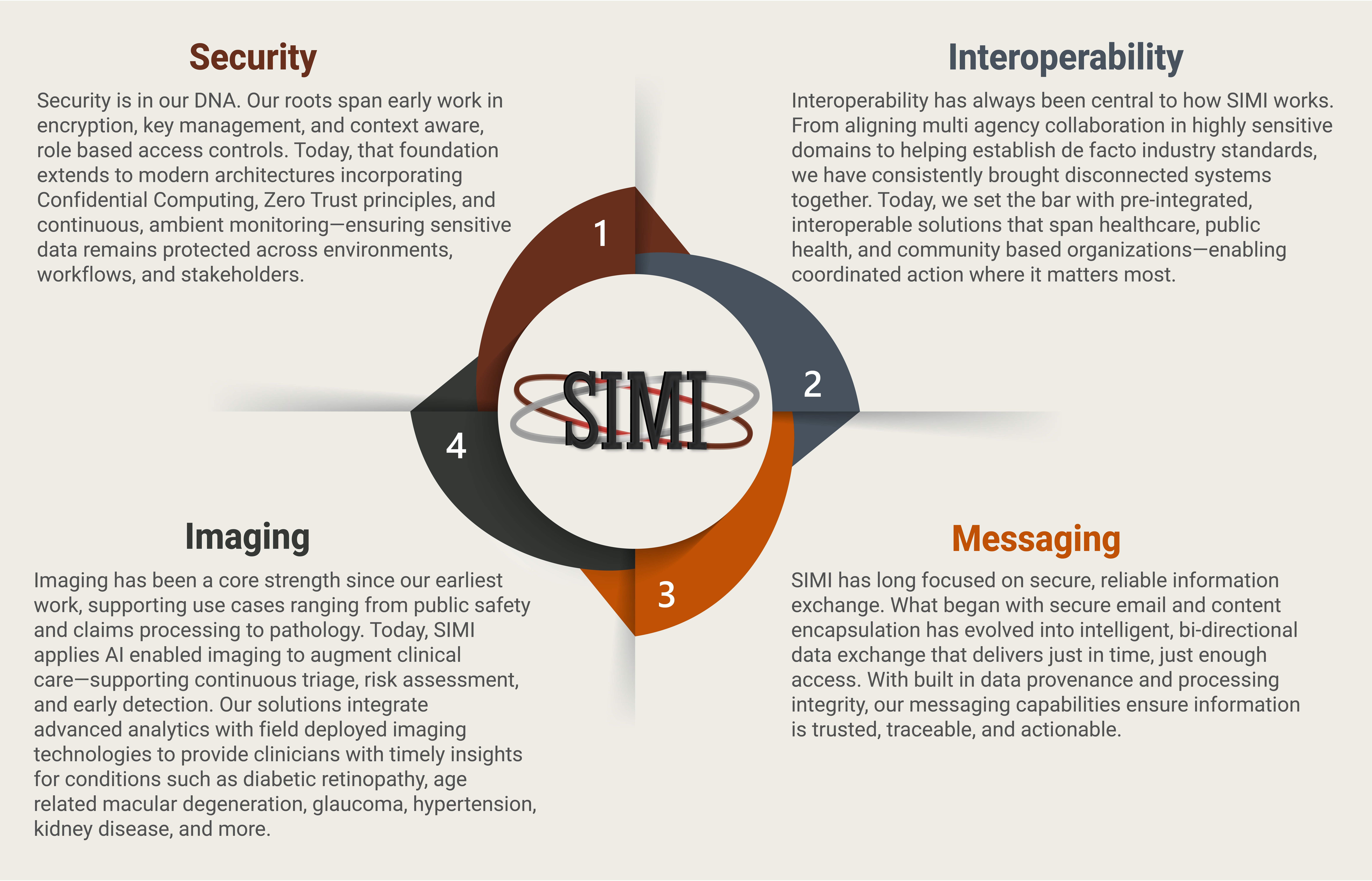
We had three years of basicaly unusable HL7 immunization data. SIMI was able to cleanse, correct, and improve the data quality by over 80% - restoring faith in our immunization information system.
We had been using the SIMI Health Alert Network system for years - little did we know how flexible it was to support communications during a wildfire with our tribal populations and remote communities.
90 days to coordinate deployment of a national surveilance network across three federal agencies, 30 of the largest metropolitan statistical areas, and fire up a national network of support. They just did it!
SIMI takes security seriously. They were the first organization in memory that received a perfect score on our thorough healthcare partner risk assessment
Using the Health Hub, we were able to shift many resources from entering data and answering phones to doing the practice of public health. Our residents are the true beneficiaries.
It was the height of the pandemic and others were just turning on the feed – voluntarily. They caught compliance and minimum necessary and appropriate disclosures within minutes, and we cut the data feed off. Imagine sending a full patient medical record with behavioral health, substance abuse, and gender identity to the federal government – for a negative case of COVID!
We had two months to prepare for a health fair that was bringing three health systems, digital eye examinations, AI-augmented clinical readings for diabetic retinopathy, AMD, glaucoma, continuous triage and more. SIMI was recommended. SIMI came in a delivered in spades – and helped to deliver 100% patient follow-up that was identified in over 60% of the individuals! Amazing!